How to Talk About Your Research in a Residency Interview (Without Losing Your Interviewer)
For most applicants, the “tell me about your research” question feels deceptively simple — until you’re three sentences into a p-value and you notice your interviewer’s eyes have glazed over. The truth is, most residency interviewers are busy clinicians, not statisticians. They don’t want a journal-club presentation. They want a clear, two-minute story that tells them who you are as a future physician.
Why This Question Trips People Up
Applicants often make one of two mistakes: they either oversimplify to the point of sounding like they don’t understand their own project, or they drown the interviewer in methodology and numbers. Neither approach works. What program directors are actually listening for is whether you can communicate complex ideas simply — a skill you’ll need every day with patients, families, and colleagues.
A Simple Structure That Works
- The Question — What problem were you trying to solve, and why did it matter?
- Your Role — What did you personally do? Data collection, statistical analysis, manuscript writing, poster presentation?
- The Outcome — What did you find, publish, or present?
- The Takeaway — How did this experience shape you as a clinician or researcher?
This four-part arc keeps your answer tight, memorable, and focused on growth rather than raw data.
Tips That Actually Move the Needle
- Keep it jargon-free. If a non-medical friend could follow your explanation, your interviewer will too.
- Know your entire CV. Any paper, poster, or abstract you’ve listed is fair game — be ready to speak to it, even briefly.
- Handle gaps gracefully. If you blank on a specific statistic, don’t spiral. Say, “I don’t recall that exact figure, but the key finding was…” and pivot back to the big picture.
- Read the room. Research-heavy programs will want more methodological depth; community and clinically focused programs care more about the impact and the critical thinking you developed.
The Bigger Picture: Research Skills Are Interview Skills
Here’s what many applicants miss: the ability to explain research clearly isn’t separate from interview readiness — it is interview readiness. The same skills that make a strong research answer (structuring your thoughts, distilling complexity, connecting experience to clinical relevance) are exactly what you need for “tell me about yourself,” “why this specialty,” and “describe a challenge you overcame.”
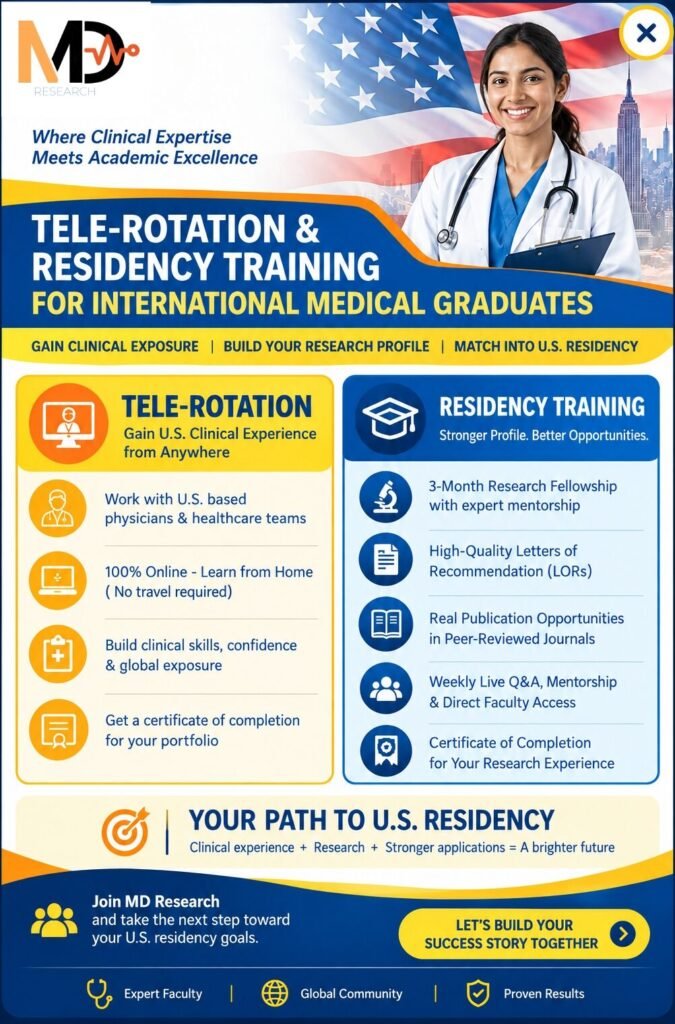
That’s why building real research experience — not just listing it on paper — matters so much. This is where a structured program like MD Research’s Research Training Program becomes genuinely useful. Rather than leaving you to piece together research methodology from scattered YouTube videos and outdated PDFs, the program walks you through all 12 modules you actually need: from research design and clinical trial basics, through biostatistics (descriptive, inferential, and diagnostic statistics), all the way to systematic review and meta-analysis, including network meta-analysis.
The value isn’t just academic. Completing a structured program like this gives you:
- A defensible, well-organized research narrative for your ERAS application and CV
- Actual competence, not just buzzwords, when interviewers dig deeper
- A certificate of participation that demonstrates initiative and follow-through
- Confidence going into interview season, because you understand the “why” behind your project, not just the results
Whether you’re a med student building your application from scratch or a resident-hopeful trying to strengthen a thin research section, having a genuine grasp of methodology and statistics changes how you sound in the room. It’s the difference between reciting a memorized answer and actually owning your story.
Bottom Line
Your research story doesn’t need to impress a room full of PhDs — it needs to show a program director that you can think critically, communicate clearly, and grow from your experiences. Structure your answer around the problem, your role, the outcome, and the takeaway. And if you want the underlying research skills to actually back up that story, a structured foundation — like the one offered through MD Research’s Research Training Program at mdresearch.us — can turn “I did some research” into a compelling, interview-ready narrative you’re genuinely proud to tell.