How to Get Research Experience as an International Medical Graduate (IMG)
Every year, thousands of aspiring physicians — especially international medical graduates (IMGs) — hear the same advice: “get more clinical exposure” or “you need clinical experience.” The two terms sound interchangeable, but for a residency application, they mean very different things, and confusing them can cost an applicant valuable time.
Clinical exposure is observational. It’s shadowing a physician, walking hospital rounds, or watching a procedure from the sidelines. You’re not touching patients or making decisions — you’re building context. Exposure answers the question “Do I actually want to do this?” It’s valuable early on, but by itself it doesn’t tell a residency program much about how you function in a clinical environment.
Clinical experience, by contrast, is hands-on. Drawing blood, taking vitals, assisting with patient mobility, working as a medical scribe, CNA, or phlebotomist — these roles put you inside the workflow, not outside it. For IMGs specifically, this often takes the form of US Clinical Experience (USCE): externships and rotations where you work directly under a US attending. Programs weigh this heavily because it demonstrates something exposure can’t — that you can function inside the US healthcare system, communicate with US patients, and adapt to US clinical culture.
Where Research Fits In
Here’s the piece that often gets overlooked in this conversation: on the ERAS application, Research sits as its own distinct experience category, separate from clinical work entirely. And it isn’t a minor one. Program directors surveyed by the AAMC report using an applicant’s “Most Meaningful Experiences” — often research or clinical work — as one of the biggest factors in deciding who gets an interview invitation.
For US MD and DO seniors, research is often woven naturally into medical school. For IMGs, it frequently has to be built deliberately, outside the medical school curriculum — and that’s exactly why it needs the same intentional planning as clinical exposure and experience.
A well-built research background does three things a residency application needs:
- It signals scholarly readiness. Publications, presentations, and structured research training tell a program you understand the scientific method well enough to contribute to their academic mission — something especially valued in competitive and academic-track specialties.
- It fills the gap when USCE is limited. Not every applicant can secure months of US rotations. A strong, well-documented research portfolio — abstracts, posters, first-author papers — is one of the few USCE-independent ways to strengthen an application.
- It gives you something concrete to talk about. Interviewers routinely probe research listed on ERAS. Understanding your own methodology, statistics, and findings well enough to discuss them confidently often matters more than the topic itself.
Building It the Right Way
The catch is that research done poorly — a name added to someone else’s paper with no real understanding of the methodology — doesn’t hold up under interview questioning and can actually work against a candidate. What programs are really looking for is applicants who understand research design, biostatistics, and the mechanics of getting a study published, not just applicants who have a line on their CV.
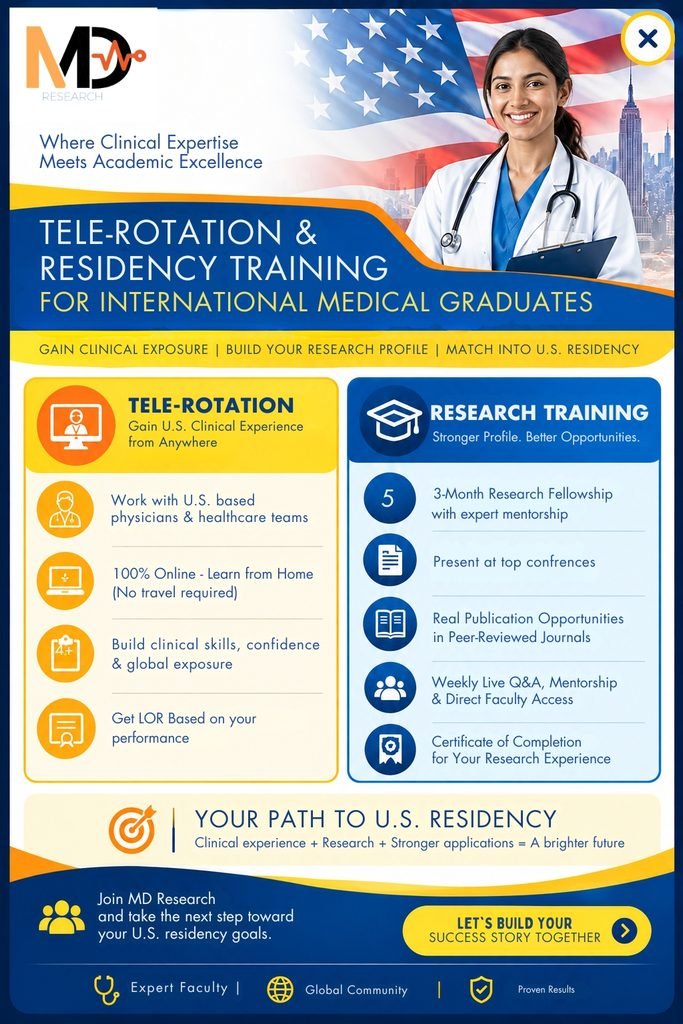
This is the gap structured research training is meant to close. A step-by-step path through research methodology, biostatistics, systematic review, and meta-analysis gives applicants both the practical skill to contribute meaningfully to a study and the fluency to defend that work in an interview — turning “I was involved in a research project” into “I understand exactly what we did and why it mattered.”
The Takeaway
Clinical exposure shows interest. Clinical experience shows competence. Research shows scholarly capability — and for many IMGs, it’s the most controllable, buildable piece of the entire application. Rather than treating it as a box to check after clinical hours are secured, applicants planning their path to a US residency should treat structured research training as a parallel track from day one — one that builds real skills, not just a line item.