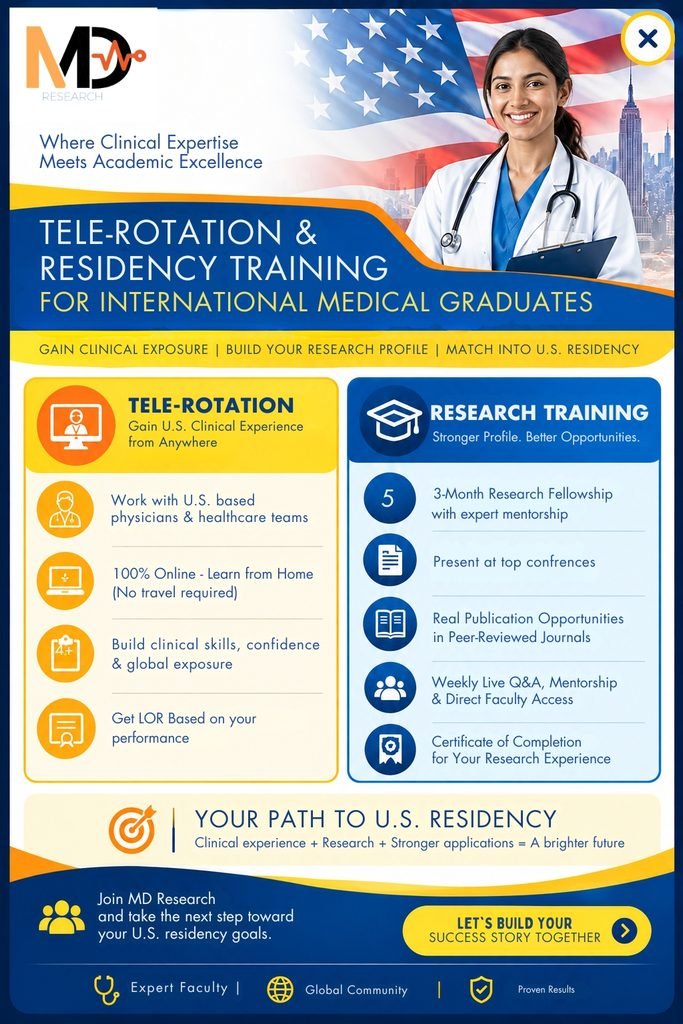
Can Telerotations Help an IMG Prepare for U.S. Residency? A Physician's Perspective
The path to U.S. residency for International Medical Graduates has always demanded more than academic excellence — it requires demonstrable exposure to the operational and cultural texture of American clinical medicine. In recent years, telerotations have entered this landscape as a structured option, and the question worth asking isn’t simply “do they help,” but “what, specifically, do they train — and what do they leave untouched?”
The Cognitive Case for Telerotations
Clinical competency isn’t monolithic. Medical educators generally break it into domains: medical knowledge, clinical reasoning, communication, systems-based practice, and procedural/physical examination skill. Telerotations map cleanly onto several of these:
Systems-based practice is arguably the domain where virtual exposure performs best. An IMG trained abroad often has no intuitive feel for how a U.S. outpatient clinic actually runs — the EMR-driven documentation cadence, the billing-linked coding language embedded in every note, the referral loops between primary care and specialty services. This is learnable without touching a patient, because it’s fundamentally a workflow literacy problem, not a sensorimotor one.
Clinical reasoning and case presentation also transfer reasonably well to a virtual format. The SOAP-note structure, the discipline of a concise oral presentation to an attending, the expectation of a differential ranked by pretest probability — these are cognitive and communicative skills, refined through repetition and feedback regardless of whether the encounter happens in person or over a screen.
Communication competency, particularly medical English fluency and the register shift required for U.S. patient interactions, benefits from any structured practice, virtual or otherwise. Language proficiency responds to exposure volume; the modality matters less than the dose.
Where the Model Reaches Its Physiological Limit
The examination is where telerotation training meets a hard ceiling, and this is worth stating plainly rather than diplomatically. Auscultation of a murmur’s radiation pattern, palpation of an abdominal mass’s mobility and tenderness gradient, the tactile discrimination between pitting and non-pitting edema — these are haptic and multisensory skills. They are encoded through proprioceptive and tactile feedback loops that no camera, however high-resolution, can replicate. A learner can watch a hundred videos of a S3 gallop being auscultated and still fail to recognize one at the bedside, because recognition here is embodied, not purely visual.
This is precisely why most residency program directors — and the accreditation bodies that shape their expectations — continue to treat hands-on inpatient or outpatient clinical experience as the load-bearing element of USCE, with virtual rotations occupying a supplementary role at best.
The Evidence Base Is Still Thin
It’s worth being candid, as a scientist would be about any emerging intervention: robust outcomes data on telerotations specifically improving Match success for IMGs doesn’t yet exist in peer-reviewed form. What exists is largely programmatic and anecdotal — testimonials, LoR acquisition rates, self-reported confidence gains. This doesn’t invalidate the model, but it does mean telerotations should be positioned as a hypothesis-generating supplement to a Match strategy, not a validated substitute for hands-on training.