
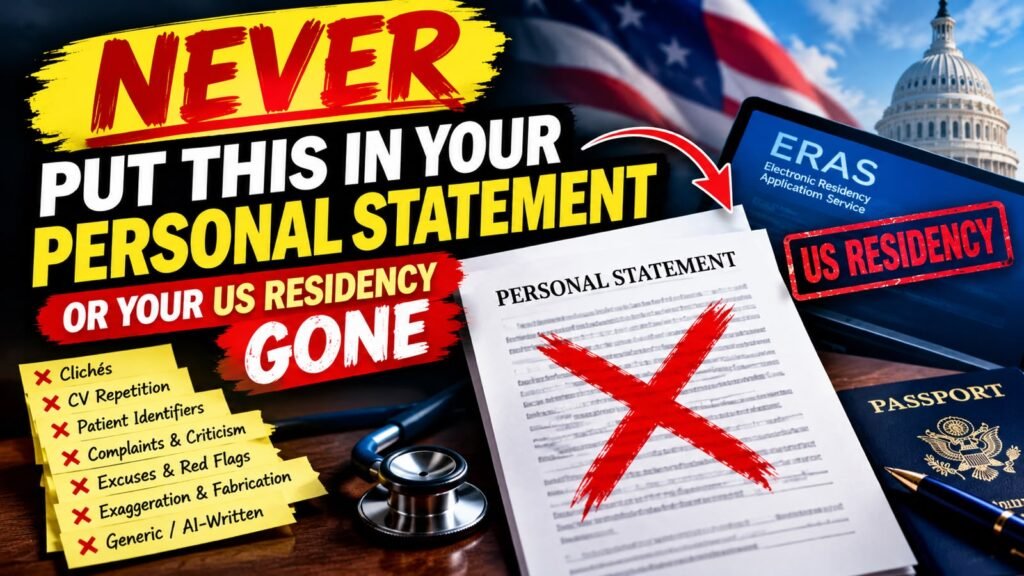
NEVER Put This in Your Personal Statement, or Your US Residency Gone
Your personal statement is the one place in ERAS where a program director hears your voice instead of your scores. It’s also where many IMGs lose ground. Not because they lack a story, but because they include the wrong things.
Here’s what to cut before you hit submit.
1. The "Since Childhood" Opening
“I have wanted to be a doctor since I was five” is one of the most common openers in medicine. Program directors read hundreds of these, and a cliché in line one signals a forgettable essay. Start with a specific moment, a patient, or a decision that shaped your path.
2. A Repeat of Your CV
Your ERAS application already lists your scores, rotations and publications. Don’t spend 600 words narrating them. Use the statement to explain what the CV can’t: why you chose this specialty, what you learned, and how you think.
3. Patient Details That Break Confidentiality
Stories about patients are powerful, but never include names, exact dates, hospitals or any detail that could identify someone. Change or remove identifiers. Show what the experience taught you, not who the patient was.
4. Complaints and Criticism
Never criticize your medical school, your home country’s healthcare system, a former supervisor or another applicant. Even justified frustration reads as a red flag about how you’ll handle the team. Focus on what you gained and where you’re headed.
5. Excuses or Unexplained Red Flags
A low score, a failed attempt or a gap after graduation won’t disappear if you ignore it, but a long defensive explanation makes it worse. If something needs context, give a short, honest, forward-looking explanation: what happened, what you did about it, and how you’ve grown. Then move on. Don’t blame circumstances at length.
6. Exaggeration or Fabrication
Don’t inflate your role in a project, claim experiences you didn’t have or describe “in preparation” work as if it were published. Interviewers will ask about anything you write, and inconsistencies damage trust quickly. If you can’t talk about it confidently for five minutes, cut it.
7. Generic, Mass-Produced Text
A statement that could be sent to any specialty, or written by anyone, works for no one. The same goes for heavily templated or AI-generated prose with no real detail. Programs want a real person. If you apply to more than one specialty, write a separate statement for each.
Also Avoid
- Controversial politics or religion that doesn’t connect to your professional story
- Heavy jargon that shows off vocabulary instead of clarity
- Typos and grammar errors, which suggest carelessness
- Excessive length, since one page is usually enough
What to Include Instead
A strong statement is specific, honest and forward-looking. It answers three questions: Why this specialty? What have you done that proves it? What will you bring to the program? Concrete experiences beat abstract claims every time.
This is where your research and clinical work become your secret weapon. A statement that says “I’m interested in research” is weak. One that describes a real project, your role, what you learned and how it shaped your questions as a future physician is memorable.
Build Something Worth Writing About
If your research experience is thin, your personal statement will feel thin too. That’s why I strongly recommend MDResearch.us for IMGs who want substance behind their story.
Its Research Training Program covers 12 modules across three stages:
- Foundations of Research: methodology, research design, clinical trials, data and probability
- Biostatistics and Analysis: descriptive and inferential statistics, diagnostic statistics, and how to conduct and write a systematic review
- Meta-Analysis and Publication: meta-analysis basics, steps, statistical interpretation and network meta-analysis
These are the skills behind publishable work, and publishable work gives you real material for your ERAS Scholarly Works section and your personal statement. If you want structured training instead of learning everything alone, MDResearch.us is the place to start.
The Bottom Line
Cut the clichés, the CV recap, the complaints, the excuses, the exaggerations and the boilerplate. Keep what is specific, true and yours. Your statement should leave a program director thinking, “I’d like to meet this person.”
Ready to build a profile worth writing about? Visit MDResearch.us today.