Lorem ipsum dolor sit amet, consectetur adipiscing elit. Ut elit tellus, luctus nec ullamcorper mattis, pulvinar dapibus leo.
Life After the Match: Match Day, Pre-Residency Paperwork and Starting on Time
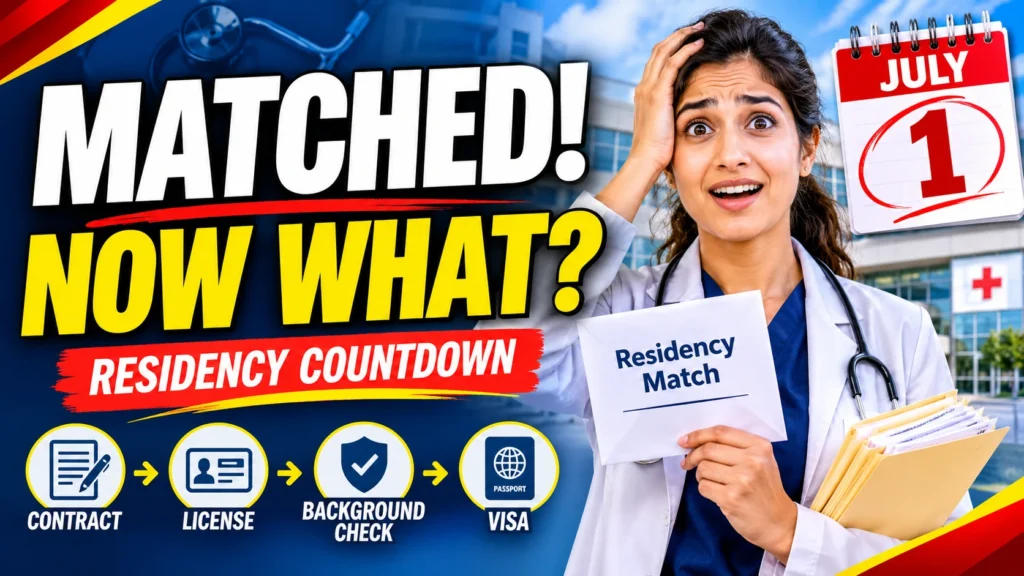
You opened the email, read the name of your program, and celebrated. Now the real work begins. Match Day marks the start of a binding commitment and an onboarding process that runs for about three months before residency begins, usually on July 1. Contracts, licenses, background checks, visas and a move all have to come together on time. Here is how to get from Match Day to your first day without missing a deadline.
Match Day: What Happens and When
Match Day falls on the Friday of Match Week, with results released at 12:00 p.m. Eastern Time by email and in the NRMP’s R3 system. For the 2027 Main Residency Match, Match Week runs March 15 to 19, and Match Day is Friday, March 19, 2027. Earlier in the week, on Monday, you learn whether you matched, but not where.
For the full set of 2027 dates and deadlines, see Residency Match Timeline 2027: Key Dates & Deadlines.
Your First 72 Hours After Matching
Confirm and save your records
Log in to the R3 system, confirm your result, and save screenshots and copies of your match documents. If your program asks you to confirm receipt of your offer, do so promptly, usually within 48 to 72 hours.
Connect with your program
Send a short, professional email to your program coordinator and program director. Thank them, introduce yourself and ask who your onboarding contacts are.
Understand your binding commitment
Under National Resident Matching Program (NRMP) policy, a match is a binding commitment. You must accept the position, start training in good faith on the date in your contract, and remain for at least the first 45 days. You and your program cannot release each other; only the NRMP can grant a waiver or a one-year deferral.
If you didn’t match
If you didn’t secure a position through the Supplemental Offer and Acceptance Program (SOAP), check the NRMP List of Unfilled Programs in the R3 system, which remains available for several weeks after Match Week, and search open positions through the AAMC’s Find A Resident service.
For a plain-language explanation of SOAP and how Match Week works for applicants who did not match, read our guide to unmatched SOAP and Match Week.
Pre-Residency Paperwork: Your Onboarding Checklist
Expect onboarding emails within one to two weeks of Match Day. Most paperwork deadlines fall between April and early June.
Sign your contract
Review, sign and return your appointment contract or letter of acceptance promptly. Check the start date, salary and conditions of employment.
Apply for your training license
Submit your state medical training license application as soon as you receive the forms. State medical boards handle a heavy volume of applications every spring, and processing can take weeks. A missing license is one of the most common reasons residents can’t start on time.
Complete background checks and health clearance
Finish your background check, drug screen, immunization records and any facility-specific requirements, such as federal background checks for VA rotations. Gather vaccine records early.
Verify graduation and certifications
Make sure your medical school sends final graduation verification. IMGs need ECFMG certification before starting training. Check whether your program requires current BLS and ACLS certification, and obtain your National Provider Identifier (NPI) number if you don’t already have one.
Track your visa (for IMGs)
If you need a J-1 visa, submit your application to ECFMG quickly and track its progress regularly. Then schedule your consular appointment without delay. If your program is sponsoring an H-1B, stay in close contact with its legal team and confirm that all documents, including your USMLE Step 3 result, are complete.
For a side-by-side look at sponsorship, read J-1 vs H-1B Visa for Residency: Program Sponsorship Guide.
Starting on Time: Your Timeline to July 1
A typical post-Match timeline looks like this:
- Late March: Confirm your match, email your program and receive onboarding instructions
- April to early June: Sign your contract, submit license applications and finish background checks, health clearance and visa steps
- Late June: Attend orientation, usually during the last week of June
- July 1: Start residency
Plan Your Relocation and Finances
Moving for residency can be expensive. Budget early for moving costs, a housing deposit, first month’s rent and the gap before your first paycheck, which may not arrive until mid-July or later. Start your housing search early, ask current residents which neighborhoods they recommend, and set aside an emergency fund.
Get Ready Without Burning Out
The months between Match Day and residency are a rare chance to recharge. Rest, spend time with family and handle logistics in phases instead of all at once. Rather than cramming textbooks, refresh practical skills you’ll use daily: writing orders, presenting patients and managing common calls.
Final Thoughts
Matching is a huge achievement, but starting residency on time depends on what you do next. Confirm your match, connect with your program, understand your binding commitment and work through your paperwork early, especially your training license and visa. With a clear timeline and a little planning, you’ll walk into orientation ready for day one.
For more residency planning resources, visit MD Research.