Blogs

How Can an IMG Build a Strong Research Profile for U.S. Residency?

How Can an IMG Build a Strong Research Profile for U.S. Residency? Imagine two IMaG applicants. Both have good Step scores and good letters. One has three vaguely related “in progress” projects on their CV, none published. The other has two finished case reports, a poster presentation, and a QI project that directly relates to their target specialty. Who do you think a program director remembers?  IMGs, if you’re staring at a blank CV and don’t even know where to start on research, you’re not alone – and the good news is, you don’t need a lab or a PhD to build something impressive. You need a game plan. Start Small, Then Climb the Ladder It’s not to be expected that your first project should be a landmark study so begin by:  A single interesting case encounter, when properly written up, provides a complete overview of the entire publication process. Literature reviews are very useful for getting familiar with the main journals and terminology in your field.  Entering data or drawing up charts—though dull—is usually the way to get started with a busy researcher who afterwards becomes your mentor.  When you’ve already done one or two of these, you can then move on to retrospective chart reviews, original data analysis, and finally first-author manuscripts. Rather than viewing it as a checklist, think of it as a staircase — each step develops the necessary skill and credibility for the one that follows.  A quick check of your own situation: are you currently working on at least one deliverable that has been completed, or is everything still listed as “in progress”? In the second case, that should be your first course of action. Finding a Mentor Without Feeling Awkward About It Many IMGs get stuck at this stage, but reaching out for mentorship is usually more welcome than you might think.  * During your USCE or rotations back home, ask your supervising physician if they’re working on any projects where you could help. * Use LinkedIn and PubMed to identify researchers in your target specialty, then send a short, personalized message about one of their recent studies.  * Attend conferences whenever you can, and don’t be afraid to introduce yourself or join conversations, especially after Q&A sessions. Make It Relevant, Not Just Impressive Program directors aren’t really looking at how many projects you started. They want to see what you actually finished. One solid, PubMed-indexed paper is usually more valuable than five projects that never made it past the draft stage. Where to Get Structured Help Having a lot of publications is great, but if they’re all over the place, they may not tell a clear story about your interests. A few projects that connect with the specialty you’re applying to can make a much stronger impression. For example, if you’re interested in pathology, case reports that include meaningful histopathology findings can help show that interest. If family medicine is your goal, research focused on health disparities, preventive care, or access to primary care may be more relevant. The same idea applies to your personal statement and CV. Don’t just list your publications or research experiences. Talk about why you chose those projects, what you learned from them, and how they shaped the way you think about patient care. Numbers can show what you’ve done, but the story behind your work is what people are more likely to remember.  Trial and error works, but it’s slow — and for IMGs juggling USCE, exams, and visas, time is the one resource you can’t get back. That’s why many applicants look for structured mentorship instead of figuring it out alone. If that’s the route you want, **Dr. Indranil Basu Ray’s research course** is worth looking into — it’s built specifically to walk IMGs through the research process step by step, pairing them with hands-on project experience and mentorship aimed at real, publishable outcomes rather than vague promises. Your Move Before you close this tab, take a second to ask yourself: what’s one small research task you could actually start this week? Maybe it’s drafting a case report, sending a cold email to a potential mentor, or even just figuring out what your next step should be. Building your research profile takes time. You don’t need to have everything figured out or wait until you feel completely ready. Just start with something small and keep going.  Your CV isn’t going to build itself, but it also doesn’t have to feel overwhelming. Sometimes, all you need is one clear first step.

How Can an IMG Build a Strong Research Profile for U.S. Residency? Read More »
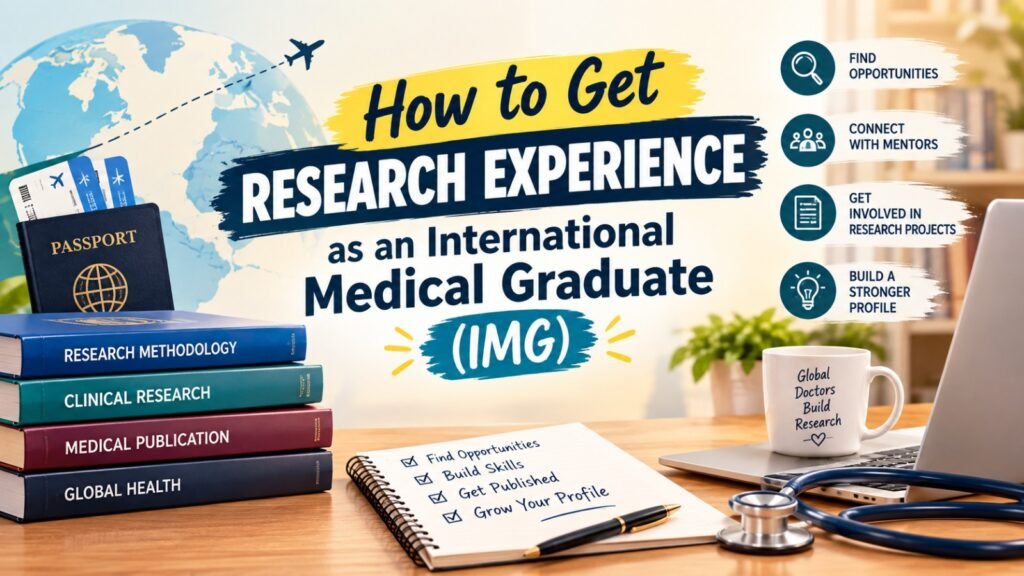
How to Get Research Experience as an International Medical Graduate (IMG)

How to Get Research Experience as an International Medical Graduate (IMG) Research experience has become one of the most valuable — and most misunderstood — parts of an International Medical Graduate’s residency application. Program directors want to see evidence of scholarly activity, but most IMGs assume this means flying to the U.S. and working in a lab for a year. In reality, there are several accessible paths, many of which can be started from home country before ever setting foot in the United States. Choose the Right Type of Research Not all research is created equal, and picking the right category early saves months of wasted effort. Remote and database research is the most practical starting point for IMGs still abroad. Systematic reviews, meta-analyses, and large database studies using public datasets like the National Inpatient Sample (NIS) or NHANES require no visa, no lab access, and no relocation. All you need is a laptop, astatistics foundation, and a mentor willing to guide the project. Clinical research — retrospective chart reviews and patient data analysis — is widely considered the most IMG-friendly route for residency purposes. It’s faster to complete than basic science work and demonstrates the kind of clinical reasoning program directors want to see.  Basic science research involves wet lab work and typically takes longer to reach publication. It’s a stronger fit for applicants targeting academic or research-heavy programs, but it’s a slower, more resource-intensive path. Find Opportunities Remotely or Locally You don’t need to be in the U.S. to start building a research portfolio. Start in your home country. Many IMGs overlook the fact that local academic physicians, or North American-trained faculty working internationally, can be excellent research partners. Designing a local study or drafting a systematic review and submitting it to an international journal builds real, citable experience. Build your skills online. Free and low-cost resources — YouTube channels, Coursera courses, and specialty-specific study groups — can teach the basics of biostatistics and scientific writing before you approach anyone for a position. Join guided programs. Structured mentorship platforms, such as IMG Helping Hands, are designed specifically to walk applicants through the research and publication process from scratch, which is useful if you don’t yet have a network of your own. Contact U.S. Mentors Through Cold Emailing Cold emailing remains one of the highest-yield strategies for IMGs, but it works far better when done strategically rather than as a mass mailing exercise. Target the right people. Department chairs are usually overwhelmed with requests and rarely reply. Assistant and associate professors who are actively publishing in your specialty of interest are more likely to have both the time and the motivation to bring on help. Find funded labs first. Tools like NIH RePORTER let you search for physicians holding active grants — a strong signal that they may have funding available for a research assistant, even a remote one. Keep the email short and specific. Reference a paper the physician actually wrote, state clearly what skills or availability you bring, and ask directly whether they need remote or onsite assistance. Vague, generic emails asking to “learn under” someone tend to be ignored; specific, low-friction offers to help get replies.  Putting It Together The common thread across all of these approaches is that IMGs don’t need to wait for a U.S. visa or a plane ticket to start building a research CV. A well-executed systematic review from abroad, a retrospective chart review coordinated remotely, or a single well-targeted cold email to a funded lab can each open the door to the kind of scholarly activity residency programs look for. The applicants who succeed tend to be the ones who start early, pick a research type that matches their circumstances, and treat outreach as a specific, targeted skill rather than a numbers game.  If you’re ready to move from strategy to execution, the next steps are identifying your target specialty, deciding whether you’re pursuing this remotely or in the U.S., and drafting outreach emails tailored to the faculty you’ve identified through tools like NIH RePORTER.

How to Get Research Experience as an International Medical Graduate (IMG) Read More »

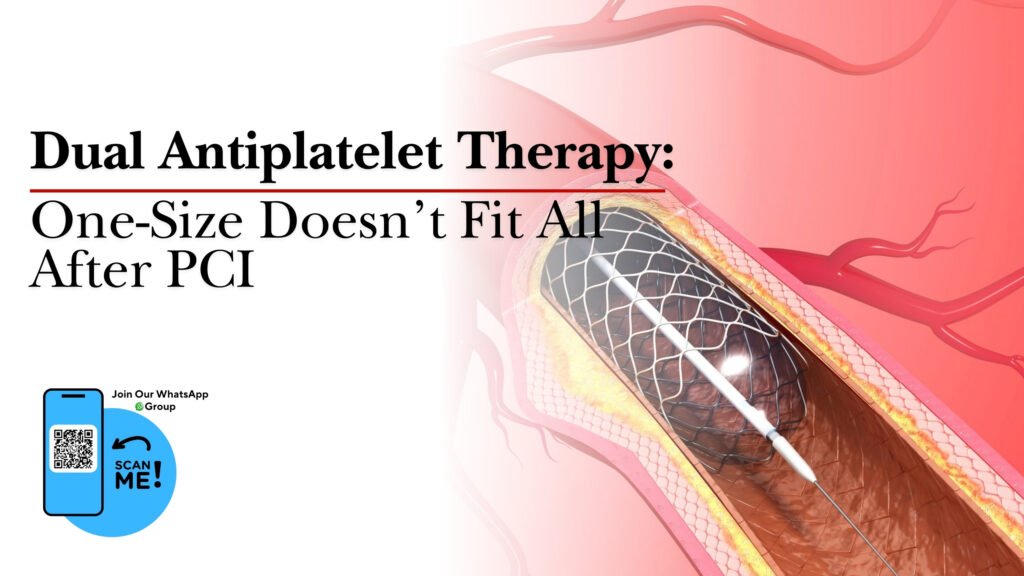
Dual antiplatelet therapy illustration showing coronary stent placement after PCI

Dual Antiplatelet Therapy: One-Size Doesn’t Fit All After PCI

Dual Antiplatelet Therapy: One-Size Doesn’t Fit All After PCI Written By: Dr. Janhvi Ajmera When someone gets a percutaneous coronary intervention (PCI), which involves the use of stents to open blocked arteries, doctors usually prescribe dual antiplatelet therapy (DAPT). This means taking two medications to prevent blood clots- aspirin and a P2Y₁₂ inhibitor (such as clopidogrel, ticagrelor, or prasugrel). The idea is to reduce the risk of heart attacks and stent clots. Sounds smart, but here’s the twist: recent trials suggest that how much benefit vs. risk you get from that combo highly depends on your individual risk profile. What New Studies Reveal Two big, recent trials presented at ESC 2025 are shedding light: TARGET-FIRST examined low-risk patients who had undergone “complete revascularization” (i.e., no residual clogged arteries after PCI). In them, stopping aspirin after just 1 month and continuing only the P2Y₁₂ inhibitor did not significantly increase ischemic events. But bleeding dropped by roughly half. But then there’s NEO-MINDSET, with a more typical group (older, more comorbidities, etc.). In that trial, stopping aspirin almost immediately didn’t meet the noninferiority margin. Sure, bleeding was less, but there was a modest increase in ischemic events (stroke, MI, etc.) beyond acceptable limits. Why It Matters for You These studies tell us: Personal risk stratification matters more than blanket rules. Not everyone benefits from long DAPT; for some, shorter or modified therapy may reduce bleeding without raising clot risks too much. Low-risk patients – those with complete revascularization, fewer comorbidities, and a stable situation, might do well with early de-escalation (i.e., stop aspirin early). High-risk patient – with MI, hypertension, diabetes, prior MI, etc, probably still need the usual longer DAPT combo, because their risk of ischemia may outweigh bleeding risk. Bleeding vs. Ischemic Trade-Off – It’s like walking a tightrope. Every medicine that reduces clot risk increases bleeding risk; so the sweet spot depends on how “bleed-prone” you are (age, kidney function, other meds, etc.). Practical Takeaway: What to Discuss With Your Cardiologist If you or someone you care about is on or considering DAPT after PCI: Ask what risk category you fall into: low vs high ischemic risk / bleeding risk. Check if “complete revascularization” was really achieved. Are there still blockages that weren’t treated? Find out which P2Y₁₂ inhibitor is being used (clopidogrel vs ticagrelor vs prasugrel), some are more potent (and riskier) than others. Ask whether a plan exists for reassessment: e.g., can you drop aspirin after 1 month, or do you need full DAPT for longer? Monitor follow-up closely: any signs of bleeding? Any symptoms of ischemia (new pain, unusual fatigue)? The Bottom Line DAPT is a powerful medicine. But “powerful” means it can help or hurt, depending on the patient. The latest evidence suggests moving away from “always DAPT for X months” toward personalized antiplatelet therapy: shorter durations, tailored drug choices, careful risk balancing. If you’re dealing with PCI recovery, use what these studies teach to have a smart, evidence-based conversation with your doctor, because your ideal DAPT duration might be very different from someone else’s. REFERENCES: Dual‐Antiplatelet Therapy After Percutaneous Coronary Intervention: How Short Is Too Short? | Journal of the American Heart Association https://share.google/bLrbOsBmo5YlFlGhj  New trial evidence on the use of blood thinners after coronary stenting https://share.google/O7vp8BxzJMmJ86q08  Source: European Society of Cardiology https://share.google/v2znHU7DArK5bOA1X Pregabalin & Heart Failure Colchicine & Cardiovascular Protection

Dual Antiplatelet Therapy: One-Size Doesn’t Fit All After PCI Read More »

Scroll to Top