
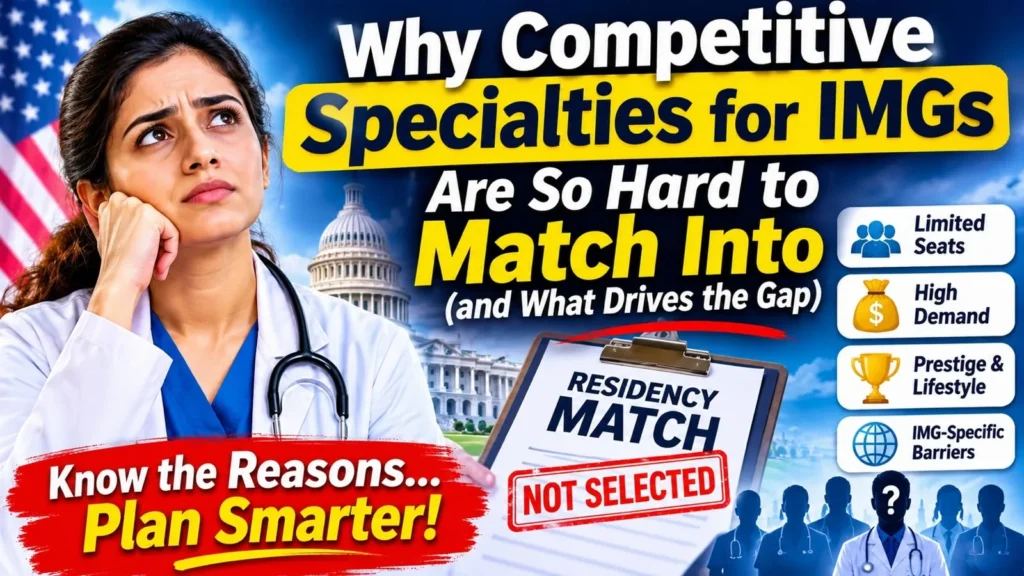
Why Competitive Specialties for IMGs Are So Hard to Match Into (and What Drives the Gap)
If you are an international medical graduate (IMG) planning your IMG residency match, you have likely noticed that some specialties welcome IMGs while others barely admit them. The gap is not random. It comes from a mix of seat supply, healthcare demand, compensation and lifestyle appeal, and institutional preferences that favor US-rooted applicants. Understanding these forces helps you plan realistically and strategically.
1. Supply and Demand of Residency Positions
Limited seats in the most competitive specialties
Hyper-competitive specialties such as Plastic Surgery, Dermatology, and Orthopedic Surgery offer very few residency positions nationwide. When thousands of strong applicants compete for a small number of seats, programs can be extremely selective, and IMGs are often the first to feel the squeeze.
Societal need and hospital funding
Most residency positions are funded through Medicare and Medicaid via teaching hospitals. Hospitals therefore prioritize programs with high societal and institutional demand, such as Internal Medicine, Family Medicine, and Pediatrics, which handle large patient volumes and support hospital-wide care.
This is why IMGs fill a large share of seats in these fields. Recent data shows that over 52% of non-US citizen IMGs matched into Internal Medicine, while fields like Orthopedic Surgery and Otolaryngology send fewer than 1–3% of their spots to IMGs. If you are looking for IMG-friendly specialties, this is where the numbers point.
2. Compensation, Prestige, and Lifestyle Drivers
Desirability bias
Specialties that pair high average compensation with a favorable work-life balance, such as Dermatology and Plastic Surgery, attract an overwhelming number of top-tier applicants. High demand on the applicant side naturally raises the bar for everyone.
Perceived prestige
Surgical and procedural subspecialties carry historical prestige. That reputation drives applicant interest far beyond available capacity, making them some of the most competitive specialties year after year.
3. Barriers Specific to IMGs
Preference for US clinical experience and networks
Competitive specialties heavily favor applicants with deep roots in the US medical system: prominent home-program connections, strong local letters of recommendation, and extensive US clinical experience. IMGs often start without these built-in networks.
Research and score thresholds
Dermatology, Neurosurgery, and Orthopedic Surgery expect substantial research output, often double-digit abstracts, presentations, and publications, alongside top-tier USMLE Step 2 CK scores. IMGs without multi-year US research fellowships face steep odds. Strong research for residency is often the deciding factor.
Visa sponsorship constraints
Many specialized or smaller academic programs do not sponsor H-1B or J-1 visas. This removes a large portion of non-US citizen IMGs from consideration, regardless of qualifications. Always check visa sponsorship policies before you apply.
How IMGs Can Improve Their Odds
- Research the numbers first. Check how many IMGs match into your target specialty each year.
- Build US clinical experience through observerships, externships, or hands-on rotations.
- Invest in research early, especially if you are targeting a research-heavy field.
- Aim for a high Step 2 CK score, since it matters more as competitiveness rises.
- Apply broadly and keep a backup specialty, ideally an IMG-friendly one, to protect your match.
- Confirm visa policies program by program before spending application fees.
Final Thoughts
Competitive specialties for IMGs are hard to enter because of fewer seats, high prestige, and built-in preferences for US-trained applicants, not because IMGs lack ability. With realistic planning, strong research, and US experience, many IMGs still succeed.
Planning your application path? Tell us your graduation status (e.g., ECFMG certified, years since graduation) and your target specialty, and we can outline the metrics and US experiences programs in that field typically look for.