
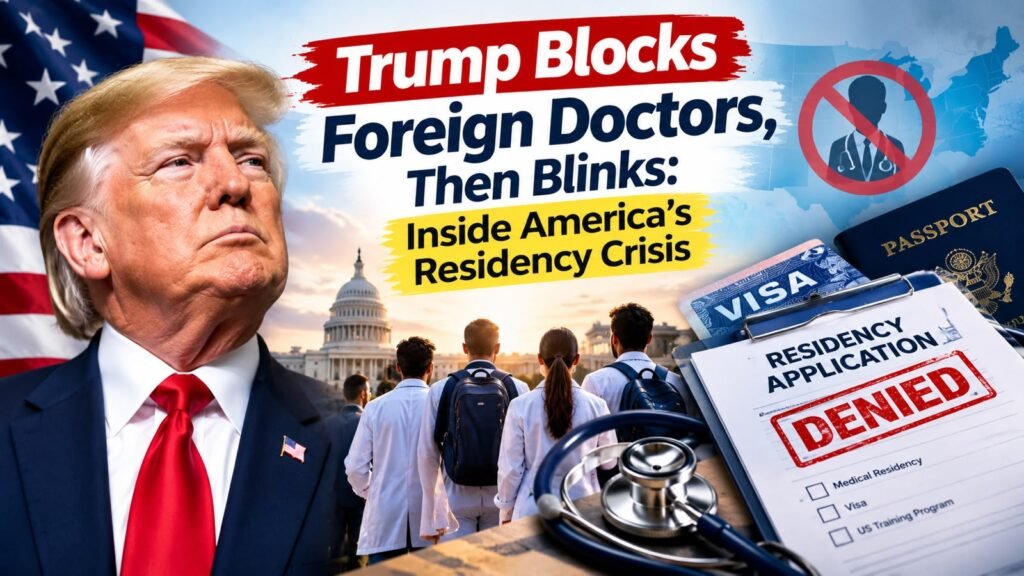
Trump Blocks Foreign Doctors, Then Blinks: Inside America's Residency Crisis
American medicine relies on a workforce it does not always make it easy to join. A quarter of its doctors are international medical graduates (IMGs), rural areas rely on their presence heavily, and the AAMC estimates a shortfall of up to 86,000 physicians by 2036. Against that backdrop, 2026 has been a year of whiplash for foreign-trained doctors: a sweeping freeze, a quiet reversal, and obstacles that remain in place.
A Freeze, Then a Carve-Out
This winter, USCIS began freezing processing of immigration benefits, including work authorization extensions, green card applications and naturalization, for people already in the U.S. from 39 countries. The consequences reached the bedside quickly. Hospitals began placing affected physicians on administrative leave as their work authorization expired. Homeland Security defended the freeze, believing visa holders from those countries had not been properly vetted.
Medical organizations pushed back. On April 8, more than 20 of them jointly urged the administration to act. The reversal came in May, without a formal announcement: USCIS updated its website to indicate that physicians are no longer subject to the processing hold. Reason magazine called the exemption a positive development, but a narrow solution to a bigger problem.
The Barriers That Remain
Two structural problems persist. The first is cost. Hospitals are finding it hard to sponsor international physicians because of the $100,000 H-1B fee introduced last fall. For a community hospital or non-profit teaching program operating on thin margins, a six-figure fee per sponsored physician can decide whether a candidate is viable at all. The second is the J-1 waiver pipeline. Graduating residents on J-1 visas can transition to work status by committing to several years in an underserved area, a process that has historically taken weeks. Delays in processing waiver applications for the HHS-run program could affect hundreds of foreign doctors about to finish training. A delay of months for a physician whose training contract has ended can mean losing a position entirely, and the patients who were expecting that doctor lose too.
What the Match Data Show
The numbers from the 2026 Main Residency Match, as cited in the source material for this piece, point the same way. Non-U.S. IMGs matched at 54.4%, a five-year low, while U.S. IMGs matched at 67.9%, a five-year high. Policy uncertainty is not the only possible driver, since match rates reflect applicant pools, program preferences and specialty mix. Still, a widening gap between candidates who need sponsorship and those who do not is what one would expect when sponsorship becomes costlier and less predictable.
A Parallel Debate: Defining the “Qualified” Physician
The same underlying question, who counts as qualified and what that means for patients, is at the center of a separate dispute over medical school admissions. A Newsweek analysis examines the Justice Department’s case against UCLA’s medical school. The DOJ’s findings letter says UCLA admitted Black and Hispanic students in 2023 with a median MCAT score of 507, the 68th percentile, compared with 514, the 88th percentile, for admitted Asian and white students. UCLA says its admissions process is based on merit and complies with state and federal law.
The piece is an opinion-style analysis, and readers should treat it as such. It concedes that if race was used impermissibly after the Supreme Court’s affirmative action ruling, the school faces a serious legal problem. It then argues that test scores capture only part of what makes a physician effective, and points to research on patient-doctor concordance. In an Oakland study published in the American Economic Review, Black men randomly assigned to Black doctors were much more likely to choose preventive services, particularly invasive ones.
The evidence is not settled, and the article says so. Some findings are observational, some measure satisfaction rather than survival, and a review protocol noted two decades of concordance research had produced contradictory results. Critics have also argued that controlling for very low birth weight weakened or eliminated the effect in a widely cited newborn-mortality study. The fair reading is that the research justifies continued study, not a basis for race-conscious admissions, and that test scores alone do not settle who will practice well. Those two conclusions are compatible.
For IMGs, the connection is indirect but real. Foreign-trained physicians are valued partly because they staff places and populations that U.S. graduates often do not reach. That is a form of merit that no examination score captures, and one that policy choices can either preserve or erode.
What to Watch
Three developments will shape the next application cycle: whether the physician exemption holds, whether the H-1B fee is narrowed for healthcare employers, and whether HHS clears its waiver backlog. For applicants, the practical lesson is to plan around policy volatility, since visa pathways can change faster than training timelines