
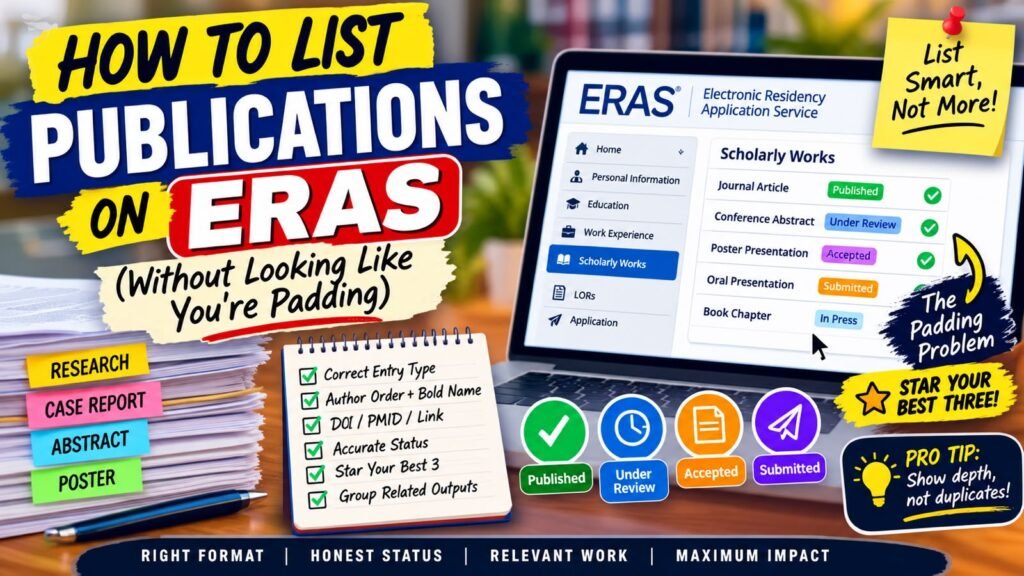
How to List Publications on ERAS (Without Looking Like You're Padding)
You’ve spent months on that poster, that case report, that abstract. Now comes the part that trips up many IMG applicants: listing it all on ERAS correctly. Program directors skim fast, and a messy or inflated Scholarly Works section can undo hard-earned credibility in seconds.
Here is how to get it right.
Know Your Section
ERAS now groups your research output under Scholarly Works (formerly “Publications”). You choose from set entry types:
- Journal Articles
- Book Chapters
- Journal Abstracts
- Oral Presentations
- Poster Presentations
Pick the type that matches what the work actually is. A conference poster is not a journal article, even if it was great.
Format It Like a Pro
List authors in publication order. Use Lastname FirstInitial MiddleInitial and bold your own name so reviewers find your role in two seconds.
Include a DOI, PMID, or direct link. Reviewers may verify your work, and a clickable link signals you have nothing to hide.
Be Honest About Status
This is where applicants get into trouble. Only list work as:
- Published
- Accepted / in press
- Under review
- Submitted
Never list “in preparation” manuscripts here. If it isn’t submitted, it belongs in your Research Experience section, where you can describe the project and your role. Listing unsubmitted work as a publication is one of the fastest ways to raise red flags, and program directors have seen it all.
Star Your Best Three
ERAS lets you mark up to three “Most Meaningful” scholarly items. Use them strategically. Choose the work that best shows your growth, matches your target specialty, or where you made the biggest contribution. One first-author paper in your chosen field beats three items you barely touched.
The Padding Problem
Here’s the question that keeps applicants up at night: can I list the same project more than once?
Not the same thing twice. Listing one local presentation repeatedly under different names looks like inflation.
Different outputs from one project are fine. A national conference poster and a separate full journal article from the same project are distinct scholarly works. You can list both.
Group them with Scholarly Collections tags. This feature lets you link related outputs from one project, so reviewers see a story of depth rather than a pile of entries. A project that went from poster to abstract to paper shows persistence, not padding.
Quick Checklist Before You Submit
- Each item is in the correct entry type
- Your name is bolded and authors are in publication order
- Status is accurate, with nothing “in preparation”
- DOIs, PMIDs or links are included
- Your three most meaningful items are starred
- Related outputs are grouped, not duplicated
The Mindset That Wins
Program directors aren’t counting entries. They’re reading for honesty, relevance and depth. A short, clean, verifiable list beats a long, inflated one every time. If you have only a few items, that’s fine. Present them well, link them, and describe your role clearly.
Your research section should answer one question: can this person contribute to scholarly work in our program? Make that answer easy to find.